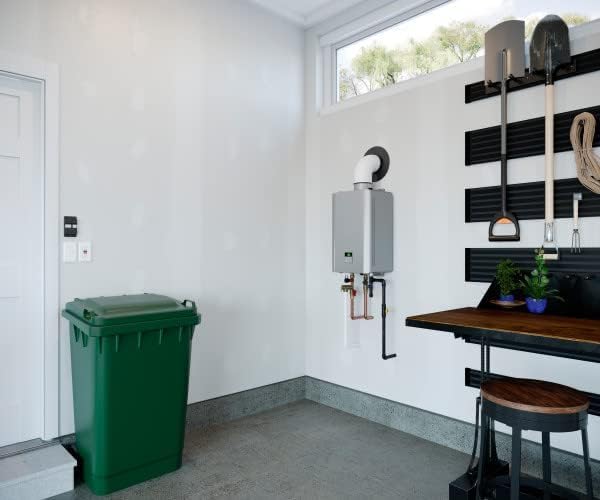
If you’re replacing a traditional water heater — the big insulated tank in your utility room — with a tankless unit, the core promise is appealing: the heater fires up on demand and delivers hot water continuously, with no tank to run dry and no standby heat loss from keeping forty gallons warm around the clock. For homeowners connected to a municipal natural gas line, that promise is relatively easy to fulfill. For rural and off-grid households running on propane (liquefied petroleum gas stored in an on-site tank), the math gets more complicated in ways that catch a lot of buyers off guard. This guide is about those complications — the flow-rate reality checks, the pressure and supply-line traps, and the decision logic that separates a smooth install from an undersized headache.
| EDITOR'S PICK[Rinnai RE180iP Non-Condensing P…](https://www.amazon.com/dp/B0CM4L8VKC?tag=greenflower20-20) | Mid-tier[Rheem RTG-70DVLP-3 High Efficie…](https://www.amazon.com/dp/B0C82611LN?tag=greenflower20-20) | Budget pick[FOGATTI Propane Gas Tankless Wa…](https://www.amazon.com/dp/B09TL75F8F?tag=greenflower20-20) | |
|---|---|---|---|
| Flow rate | 8.5 GPM | 7.0 GPM | 5.1 GPM |
| BTU rating | 180,000 | 160,000 | 120,000 |
| Condensing | ✗ | ✗ | — |
| WiFi | — | ✗ | — |
| Installation | Indoor | Indoor | Outdoor |
| Price | $1,212.40 | $804.00 | $599.00 |
| See on Amazon → | See on Amazon → | See on Amazon → |
Why Propane Changes the GPM Equation
GPM stands for gallons per minute — the volume of hot water a unit can produce in a given time. When you see a tankless unit advertised as “11 GPM,” that number is the maximum flow rate the unit can heat under ideal conditions. The operative phrase is “under ideal conditions,” and propane introduces several variables that chip away at that ceiling.
Propane BTU delivery is not the same as rated BTU capacity. A tankless water heater rated at 199,000 BTU/hr needs its fuel supply to actually deliver that energy consistently. Natural gas at municipal supply pressure (typically 0.25 PSI at the meter) is engineered for that delivery. Propane from a residential tank — especially in cold weather, when propane has trouble vaporizing quickly enough — can experience pressure drop that starves the burner. The result is a unit that throttles down mid-draw, or worse, faults out entirely.
Incoming water temperature is lower in rural areas. Groundwater temperatures in northern climates can drop to 38–42°F in winter. The U.S. Department of Energy’s overview of demand water heaters (energy.gov, “Tankless or Demand-Type Water Heaters”) notes that temperature rise — the difference between incoming cold water and your target delivery temperature — is the fundamental constraint on usable flow rate. At a 70°F rise (from 50°F to 120°F), a unit rated at 9.8 GPM might deliver 9.8 GPM. At a 90°F rise (from 38°F to 128°F), that same unit may only maintain 6.5–7 GPM before modulation kicks in.
The Numbers That Actually Matter
| Condition | Manufacturer-rated GPM | Realistic winter GPM (northern climate) |
|---|---|---|
| 50°F incoming water | 9.8 GPM @ 70°F rise | — |
| 38°F incoming water | — | ~6.5–7.0 GPM @ 90°F rise |
| Propane pressure drop (cold tank) | Full rated BTU | Up to 15–20% BTU reduction |
The takeaway: size your propane tankless unit for the worst-case scenario, not the spec-sheet headline.
Propane Supply Line Sizing: The Constraint Nobody Talks About Enough
Here is where off-grid and rural installs most commonly fail, and it rarely gets enough attention in buyer-facing content.
A condensing propane tankless unit pulling 199,000 BTU/hr is drawing roughly 2.2 gallons of propane per hour at peak. Your supply line — the gas pipe running from the regulator at your tank to the water heater — must be sized to deliver that volume without excessive pressure drop. ACHR News has published guidance on propane tankless installations noting that undersized gas lines are among the most common causes of performance complaints in rural retrofits.
Practical sizing checkpoints:
- Regulator output pressure: Most residential propane tankless units require 11 inches of water column (WC) at the unit inlet. Two-stage regulation (a high-pressure regulator at the tank, a second stage at the appliance) is strongly preferred for long runs.
- Pipe diameter and run length: A 1/2-inch CSST (corrugated stainless steel tubing) or black iron line may be adequate for runs under 30 feet. Runs over 50 feet, or installations where the water heater shares a supply line with a furnace and range, often require 3/4-inch pipe. The International Fuel Gas Code (IFGC), Table 402.4, provides the authoritative sizing tables for propane; your installer should pull and apply them, not estimate.
- Tank vaporization rate: This is the one rural buyers most often overlook. A 120-gallon propane tank in 20°F ambient air can vaporize roughly 110,000–130,000 BTU/hr before liquid dropout begins. A 199,000 BTU/hr unit on a 120-gallon tank in a cold snap will starve. The general field guidance is to size the tank at 250 gallons minimum for a dedicated whole-house tankless application in a climate that sees sustained temperatures below 30°F. A 500-gallon tank is the safer spec if the water heater shares propane supply with space heating.
Matching Units to Whole-House Load: The Decision Math
“Whole-house” is vague shorthand. The real question is: how many simultaneous fixtures do you need to serve at your target delivery temperature?
Fixture flow rates (low-flow fixtures per WaterSense program guidance, EPA):
- Standard showerhead: 2.0 GPM
- Low-flow showerhead: 1.5–1.8 GPM
- Kitchen faucet: 1.5–1.8 GPM
- Bathroom faucet: 0.5–1.0 GPM
- Dishwasher: 1.0–1.5 GPM (intermittent)
A two-bathroom rural home running two showers simultaneously plus a kitchen faucet is asking for roughly 5.5–5.8 GPM at the point of use. Account for pipe losses and mixing valve behavior, and you’re sizing against a 6.5–7.0 GPM delivered requirement. In a cold-water climate, that means specifying a unit with a manufacturer-rated capacity of at least 9–10 GPM to leave thermal headroom.
Current propane tankless units that spec-sheet analysis and aggregated installer reviews support for this load profile:
The Rinnai RUR199iP (the propane variant of the RUR199iN) is manufacturer-rated at 11 GPM with a 199,000 BTU/hr input. Rinnai’s published specifications show a 0.96 UEF (Uniform Energy Factor, the current efficiency metric), and the unit supports recirculation with its built-in pump — useful for rural homes where long pipe runs otherwise produce cold-water wait times. Owners in northern climates consistently report reliable modulation down to low-flow applications, though several long-run installer reviews on ACHR News caution that the venting requirements (Category III stainless or Rinnai’s proprietary concentric vent) add meaningful cost on retrofit installs.
The Navien NPE-240A2 (propane version) specs at 199,900 BTU/hr and 11.2 GPM manufacturer-rated, with a buffering storage tank (0.8 gallons internal) that smooths out the flow fluctuations common in variable-draw scenarios — a genuine advantage in rural homes where pressure-fed wells can produce inconsistent inlet flow. Navien’s published data shows a 0.97 UEF. Installer reviews aggregated at This Old House and ACHR News note that the NaviCirc recirculation system integrates cleanly with smart home schedules, which rural buyers increasingly request. The condensate management requirement (it’s a condensing unit) must be addressed in freezing climates; Navien’s installation manual specifies minimum drain slope and freeze protection requirements.
For buyers whose load profile is more modest — one bathroom, intermittent demand — the Rinnai V75iP at 180,000 BTU/hr and 7.5 GPM manufacturer-rated is a more defensible spec at lower installed cost, with a simpler venting footprint (non-condensing, so no condensate line).
Venting Configurations for Indoor Propane Installs
Indoor installation of a propane tankless unit is the dominant configuration for whole-house rural applications — it protects the unit from the thermal stress of outdoor mounting in cold climates, and it eliminates freeze-risk to the unit itself (though inlet water lines still need protection).
Direct-vent (sealed combustion) is strongly preferred for indoor propane installations. The unit draws combustion air from outside through a dedicated intake pipe and exhausts combustion gases through a separate flue — the two pipes often run concentrically through a single wall penetration. This isolates the combustion process from indoor air, which matters both for safety (propane combustion produces CO) and for efficiency (the unit isn’t drawing heated indoor air for combustion).
Power-vent configurations (room-air combustion, forced exhaust) are common on non-condensing propane units and add installation flexibility since they only require a single exhaust vent. They’re acceptable where makeup air is not a constraint, but building codes increasingly require combustion air calculations for rooms housing fuel-burning appliances — IFGC Section 304 governs this, and rural installs in tight modern construction often fail that calculation without dedicated combustion air provisions.
Condensing units (those achieving 0.90+ UEF) produce acidic condensate from the secondary heat exchanger. Propane combustion produces less condensate than natural gas, but “less” is not “none.” The condensate drain must terminate to an approved drain, and in climates where the drain line may freeze, heat tape or a neutralizer with freeze protection is required. ACHR News technician-filed installation notes consistently flag frozen condensate lines as the most common winter service call on condensing propane tankless units in northern rural properties.
The Decision Framework: If X, Then Y
You’ve read the specs and you’re looking at a pending purchase decision. Here’s the clean logic:
If your incoming water temperature drops below 45°F in winter AND you need to serve two or more simultaneous showers: Size to a 199,000 BTU/hr unit (Rinnai RUR199iP or Navien NPE-240A2), confirm a 250-gallon propane tank minimum, and verify gas line sizing against IFGC Table 402.4 before purchase. Budget for direct-vent installation; plan for a recirculation loop if your home has pipe runs over 50 feet.
If your load is one bathroom and intermittent demand (vacation cabin, ADU, secondary dwelling): A mid-range unit like the Rinnai V75iP at 180,000 BTU/hr is adequate and meaningfully cheaper to install, with a simpler non-condensing vent footprint.
If you’re in a cold climate and considering a condensing unit: Price the condensate management into the install estimate before you commit. The efficiency gains (0.95–0.97 UEF vs. 0.82–0.86 for non-condensing) are real and produce genuine fuel savings at current propane prices (national average approximately $2.50–$2.80/gallon as of mid-2026, per EIA data), but the payback period lengthens if condensate management adds $300–$500 to the install.
If your propane tank is under 200 gallons and shared with a furnace or range: Resolve the tank vaporization rate before specifying any high-BTU unit. This is a supply constraint, not a heater spec problem, and no amount of unit quality fixes an undersized tank in a cold snap.
The propane tankless category is genuinely capable of whole-house performance in rural and off-grid applications — the engineering supports it. The gap between the spec sheet and the lived experience almost always traces back to fuel supply, gas line sizing, or incoming water temperature. Get those three variables right, and the headline GPM numbers become attainable.