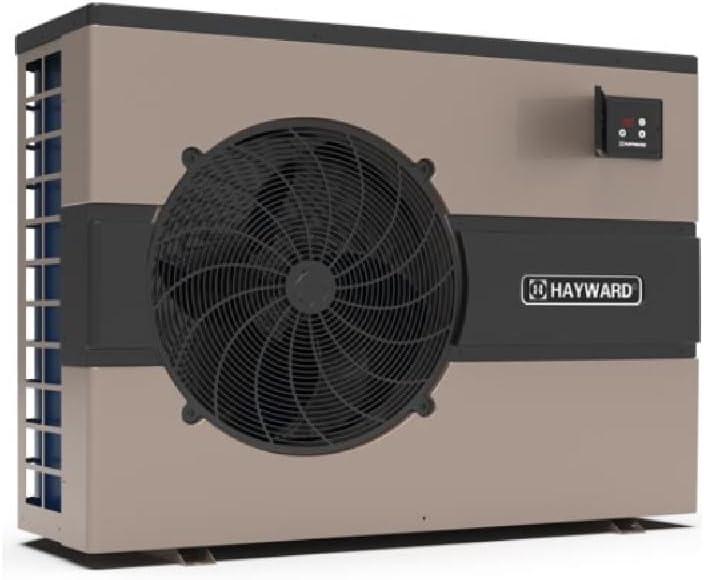
A pool heat pump works a lot like your home’s central air conditioner — just run in reverse. Instead of moving heat out of your house, it pulls warmth from the outdoor air and transfers it into your pool water. The result is a heating method that can cost 50–80% less to operate than a gas heater, because you’re not generating heat from scratch — you’re simply moving it. The catch is that sizing matters enormously. Buy a unit too small and it will run constantly, struggle to hit your target temperature, and wear out early. Buy too large and you’ve overpaid on both the equipment and installation. This guide gives you a repeatable calculation framework so you can walk into a quote — or a product listing — knowing exactly what output range you need, and why.
| EDITOR'S PICK[Hayward W3HP21404T HeatPro 140](https://www.amazon.com/dp/B0D6X9BPXB?tag=greenflower20-20) | Mid-tier[Hayward W3HP50HA2 HeatPro Heat…](https://www.amazon.com/dp/B08XY9K37J?tag=greenflower20-20) | Budget pickH5 Swimming Pool Heat Pump 18 | |
|---|---|---|---|
| BTU Output | 140,000 | — | 18,000 |
| Pool Type | In-Ground | — | — |
| COP Rating | — | — | 4.1 |
| WiFi Control | — | — | ✓ |
| Voltage | — | — | 110V |
| Max Capacity | — | — | 5,000 gal |
| Price | $6,999.00 | $2,999.00 | $599.00 |
| See on Amazon → | See on Amazon → | See on Amazon → |
Why BTU Output Is the Starting Number, Not the Finishing Touch
Pool heat pumps are rated in BTUs per hour (British Thermal Units per hour) — a standard measure of heating output. Residential pool units typically range from about 50,000 BTU/hr on the compact end to 140,000 BTU/hr or more for larger in-ground pools. Commercial or oversized residential units push higher still.
The reason so many homeowners end up undersized isn’t that they ignored BTU ratings — it’s that they used square footage instead of gallons, or they matched the unit to a neighbor’s pool without accounting for climate differences or desired temperature rise.
The core sizing formula:
BTU/hr needed = Pool Gallons × 8.34 × Target ΔT (°F) ÷ Hours to heat
Where:
- Pool Gallons = your pool’s volume
- 8.34 = the weight of one gallon of water in pounds
- ΔT = the temperature rise you want (e.g., from 60°F ambient water to 82°F = 22°F rise)
- Hours to heat = the window you’re willing to wait for initial heat-up (typically 24–72 hours)
A common real-world example: a 15,000-gallon in-ground pool, starting at 62°F, targeting 82°F, with a 48-hour heat-up window:
15,000 × 8.34 × 20 ÷ 48 = 52,125 BTU/hr minimum
That puts you squarely in the 50,000–70,000 BTU/hr bracket. A 110,000 BTU/hr unit would heat faster but cost $800–$1,200 more upfront and be overkill for maintenance mode. A 40,000 BTU/hr unit would technically heat the pool — eventually — but in cooler shoulder-season temps, it may never catch up to losses.
Above-Ground vs. In-Ground: Different Volume Profiles, Same Math
The calculation doesn’t change by pool type — but the typical volume ranges do, and that drives which product tier you’re actually shopping.
Above-ground pools are commonly 5,000–15,000 gallons. A standard 18-foot round above-ground pool holds roughly 7,600 gallons; a 24-foot round holds about 13,600 gallons. At these volumes, a 50,000–80,000 BTU/hr unit is almost always sufficient. Manufacturers like Hayward, AquaCal, and Pentair all publish sizing charts, and for most above-ground pools, owners report good results in the 50,000–60,000 BTU/hr range as long as ambient temperatures stay above 50°F (pool heat pumps lose efficiency rapidly below that threshold — more on that in a moment).
In-ground pools span a much wider range: a modest 12×24 plunge pool might hold 7,500 gallons, while a 20×40 sport pool can exceed 30,000 gallons. The U.S. Department of Energy’s Energy Saver resource on swimming pool heating recommends sizing not just for volume but for surface area, since surface evaporation is often the dominant heat loss pathway — especially for uncovered pools in windy or low-humidity climates.
By the numbers:
| Pool Type | Typical Volume | Suggested BTU/hr Range |
|---|---|---|
| Small above-ground (15’ round) | 5,000–7,000 gal | 50,000–60,000 |
| Large above-ground (24’ round) | 12,000–15,000 gal | 60,000–80,000 |
| Modest in-ground (12×24) | 7,000–10,000 gal | 70,000–90,000 |
| Standard in-ground (16×32) | 15,000–20,000 gal | 90,000–110,000 |
| Large in-ground (20×40+) | 25,000–35,000+ gal | 110,000–140,000+ |
These are starting-point brackets, not finish lines. Climate adjustment is what separates a good sizing decision from a paperwork exercise.
The Climate Coefficient: Why Location Changes Everything
Pool heat pumps extract heat from the surrounding air. Their efficiency is rated as a COP — Coefficient of Performance — which expresses how many BTUs of heat you get for every BTU of electricity consumed. A COP of 5.0 means you get 5 BTUs of pool heat per BTU of electrical input. That’s why operating costs run so much lower than gas or electric resistance heating.
The problem: COP drops as air temperature drops. Most residential pool heat pumps are rated at a COP of 5.0–6.0 at 80°F ambient air. At 50°F ambient, that same unit might deliver a COP of 2.5–3.5. Below 45°F, many units shut down entirely via low-ambient lockout protection.
Per the ENERGY STAR Certified Pool Heaters program documentation, look for units that publish COP ratings at multiple ambient temperatures, not just the optimistic 80°F figure. If you’re in Phoenix extending your swim season into March, you’ll regularly see 65–75°F nights. If you’re in the mid-Atlantic running through October, you may hit 45°F nights frequently. That difference in ambient temp can cut effective heating output by 20–30%.
Practical adjustment rule: If your climate regularly dips below 60°F during the months you want to swim, add one BTU tier to your baseline sizing. That means a pool that calculated out to a 70,000 BTU/hr need in a warm climate becomes an 80,000–90,000 BTU/hr need in a cooler one.
A pool cover also completely changes the equation. Energy Saver data indicates that a standard solar blanket can reduce heat loss by 50–70%. If you’re committed to covering the pool when not in use, you can size more conservatively. If you’ll rarely cover it — be honest with yourself here — size up.
Reading the Spec Sheet: What to Check Beyond BTU Rating
Once you’ve landed on a BTU range, here’s what to evaluate before pulling the trigger:
COP at multiple temperatures. As discussed, a unit rated at 6.2 COP at 80°F and 3.8 COP at 50°F tells a very different efficiency story than a unit that only discloses 80°F performance. This Old House’s pool heater buying guide reinforces that dual-temperature COP disclosure is the mark of a spec sheet you can actually trust.
Titanium vs. cupronickel heat exchangers. If you run a saltwater pool, this is non-negotiable — titanium is the correct choice. Cupronickel will corrode in high-salinity environments over 3–5 years. Manufacturers like AquaCal and Hayward both offer titanium-exchanger models at the mid and upper tiers.
Minimum flow rate requirements. Pool heat pumps require a minimum water flow (typically 20–40 GPM) to operate correctly. If your existing pump is undersized or your plumbing is restrictive, the heat pump’s flow switch will shut it down repeatedly, leading to what owners often misdiagnose as a thermostat or refrigerant problem.
Sound rating. Units in the 55–65 dB range are standard. If the equipment pad is close to a bedroom window or a property line, look for models with low-noise compressor enclosures — some manufacturers publish dB ratings at 10 feet; others don’t, which is itself a signal.
Defrost mode. Units designed for shoulder-season use in cooler climates should include an automatic defrost cycle. Without it, ice formation on the evaporator coil in sub-50°F conditions will repeatedly trip the unit offline. Popular Mechanics’ overview of pool heat pump operation notes that defrost mode is one of the more commonly overlooked specs by first-time buyers.
The Efficiency Math: Gas vs. Heat Pump Over a Season
Let’s run a quick operating-cost comparison for a 20,000-gallon in-ground pool in a moderate climate — say, running May through October, maintaining 82°F.
Assume 120,000 BTU/hr of heating demand across the season, totaling roughly 3.5 million BTUs of heat delivered.
- Natural gas heater at $1.40/therm (roughly the 2026 national average for residential gas): 3,500,000 BTU ÷ 100,000 BTU/therm × $1.40 = $49/month equivalent, or approximately $295/season
- Pool heat pump at COP 5.0 and $0.14/kWh electricity: 3,500,000 BTU ÷ 3,412 BTU/kWh ÷ 5.0 COP × $0.14 = roughly $29/month equivalent, or approximately $175/season
Over five seasons, that’s $600 in operating savings — which offsets a meaningful share of the heat pump’s price premium over a comparably-sized gas heater. In higher-electricity-rate states (California, New England), close-to-grid parity narrows the gap; in low-rate regions (Southeast, Pacific Northwest), the heat pump wins more decisively.
Decision Framework: If X, Then Y
After walking through the math and the spec-sheet checklist, here’s how to translate it into a clear buying decision:
If your pool is under 15,000 gallons and you’re in a warm climate (average ambient above 65°F during swim season): A 50,000–70,000 BTU/hr unit with titanium heat exchanger and a published COP above 5.0 at 80°F is sufficient. Don’t pay for capacity you won’t use.
If your pool is 15,000–25,000 gallons, or you’re in a climate with shoulder-season temps that dip below 60°F: Step up to the 80,000–110,000 BTU/hr tier and prioritize dual-temperature COP disclosure plus defrost mode. Skimping one tier here is the most common source of “the heater can’t keep up” complaints.
If your pool is above 25,000 gallons, you run a commercial application, or you’re heating a spa simultaneously: Look at 120,000 BTU/hr and above, verify minimum flow requirements against your pump spec, and get an HVAC-certified pool technician to confirm refrigerant line sizing before installation.
If you have a saltwater pool, regardless of volume: Titanium heat exchanger is the non-negotiable line item. Don’t compromise on this to save $150 upfront.
If operating costs are the primary driver: Run the BTU-per-dollar math for your specific electricity rate before assuming the heat pump wins. In high-rate markets above $0.20/kWh, the efficiency advantage compresses — the heat pump still typically wins, but the payback period stretches from 3–4 years to 5–7 years.
The sizing formula isn’t glamorous, but it’s the thing that separates a purchase you’ll be satisfied with from one you’ll be calling a contractor about in year two. Get the gallons right, adjust for your climate, read the full spec sheet — and the decision gets a lot easier.