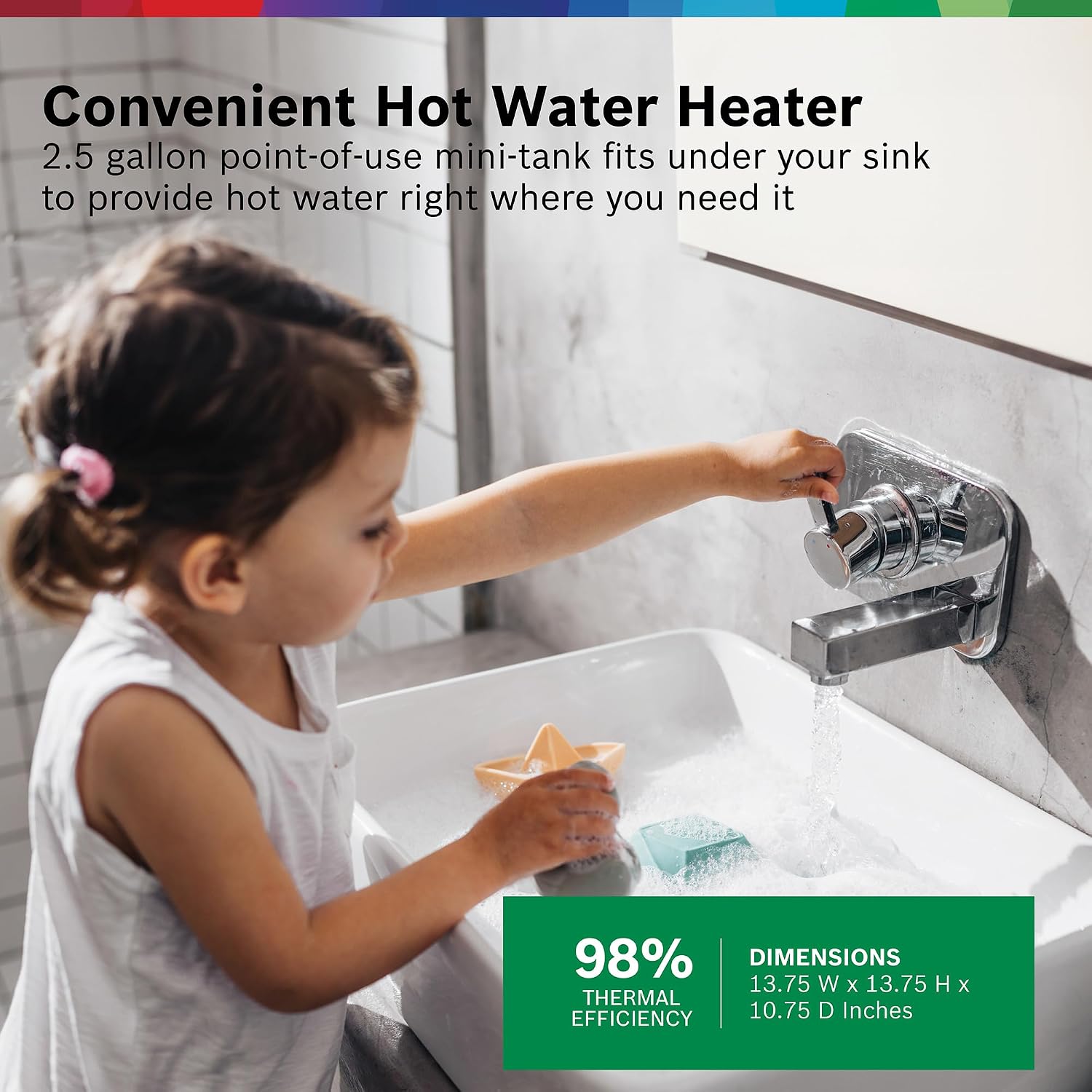
You’ve probably done it a hundred times: turn on the kitchen faucet, run it for ninety seconds while washing vegetables or rinsing a pan, and feel only cold water. The hot water is sitting in your central water heater — maybe forty feet of pipe away in the basement — and every drop of cold water you flush down the drain while waiting is wasted energy and wasted water. A point-of-use (POU) mini-tank water heater is a small electric tank, typically 2.5 to 20 gallons, installed directly under the sink (or inside a cabinet near a fixture). Because it’s just inches from the faucet, hot water arrives almost instantly. This guide will help you decide whether a POU unit is the right fix for your situation, which capacity actually fits your use case, and where the real installation gotchas live — the ones that don’t show up on the spec sheet.
| EDITOR'S PICK19 Gallon | Mid-tier[Thermomate Tank Water Heater](https://www.amazon.com/dp/B0CL9M23XX?tag=greenflower20-20) -… | Budget pick[BOSCH Electric Mini-Tank Water](https://www.amazon.com/dp/B0148O658Y?tag=greenflower20-20)… | |
|---|---|---|---|
| Capacity | 19 Gallons | 10 Gallons | 2.5 Gallons |
| Power | — | 1500W | — |
| Voltage | 120V | 120V | — |
| Mount Type | — | — | Shelf, Wall or Floor Mounted |
| UL Listed | — | ✓ | — |
| Price | $351.50 | $284.99 | $225.99 |
| See on Amazon → | See on Amazon → | See on Amazon → |
Why the Long Wait Exists — and Why a Bigger Central Tank Won’t Fix It
The wait for hot water has almost nothing to do with your central water heater’s size or efficiency rating. It’s a dead-leg problem: the pipe run between your water heater and the fixture has to be purged of the cold water sitting in it before hot water can arrive. The longer and smaller the pipe, the longer the wait.
Per the U.S. Department of Energy’s Energy Saver resource on reducing hot water use, American households waste an estimated 1.1 trillion gallons of water per year on distribution losses — a significant portion of that is simply waiting-for-hot-water waste at fixtures remote from the central heater.
There are three conventional solutions to a dead-leg problem:
- Recirculation loop with a pump — keeps hot water moving through a dedicated return line so the pipe never goes cold. Works well for whole-home applications, but it adds standby heat loss 24/7 and requires a return line that most retrofit situations don’t have.
- Demand-controlled recirculation — a pump on a timer or occupancy sensor that only runs before you need hot water. Better efficiency than always-on, but adds complexity and still requires a return line or a cold-water bypass valve under the sink.
- Point-of-use mini-tank — a dedicated small tank at the fixture. Zero pipe wait. No return line needed. Installs in under two hours in most cases.
The POU mini-tank wins the simplicity comparison for a single remote fixture — especially a kitchen sink, a garage utility sink, or a master bath addition far from the mechanical room. Where it doesn’t win is whole-home coverage, high-flow applications, or situations where the fixture is already close to the central heater.
Sizing a POU Tank: Capacity Is Not the Place to Overspecify
This is where most buyers over-buy — and overspending on capacity here means overspending on standby heat loss every day for the next decade.
The core math: A kitchen sink draw for hand-washing or food prep runs at roughly 1.0–1.5 gallons per minute (GPM). A continuous dish-rinse cycle might last two to four minutes. That’s 2–6 gallons of demand per event, usually not back-to-back.
| Use Case | Typical Draw Volume | Recommended Tank Size |
|---|---|---|
| Kitchen hand-wash / prep rinse | 1–3 gallons | 2.5–4 gallon |
| Kitchen + dishwasher hot fill boost | 3–6 gallons | 6–10 gallon |
| Bathroom vanity (single-user) | 1–2 gallons | 2.5–4 gallon |
| Garage utility / utility room sink | 2–4 gallons | 4–6 gallon |
| Light-commercial hand-sink (café, bakery) | 2–6 gallons | 6–10 gallon |
The most common POU tank sold in residential applications — the Bosch Tronic 3000 T (ES4) and Stiebel Eltron SHC 2.5 in the 2.5–4 gallon range — is sized exactly for kitchen prep use. Owners across aggregated retailer reviews consistently report that the 2.5-gallon unit handles normal kitchen activity without running cold, with full recovery in 15–20 minutes between back-to-back uses. The Rheem PROE6 6-gallon and A.O. Smith ELJH-6 step up for users who want a buffer for consecutive draws or for a supplemental role alongside an undersized zone on a tankless system.
Per ENERGY STAR program specifications, most electric mini-tanks in the 2.5–6 gallon class carry an Energy Factor (EF) between 0.93 and 0.97, which is high on paper — but those numbers reflect insulation efficiency, not total energy use. Because the tank maintains setpoint temperature continuously, a larger tank you don’t need will cost more to keep hot than a right-sized tank running the same workload.
Decision rule #1: If the fixture is kitchen-only with normal residential use, start at 4 gallons or under. Move to 6+ gallons only if you regularly run consecutive hot-water tasks without a break, or if you’re serving a commercial hand-sink with NSF compliance requirements.
Electrical Requirements: The Detail That Derails More Installs Than Any Other
POU mini-tanks are almost universally electric — gas isn’t practical at cabinet scale — and their electrical draw is modest compared to a full tankless unit, but it still needs a dedicated circuit.
Standard specs across most 2.5–6 gallon units:
- 120V / 15A circuit for tanks in the 1.2–1.5 kW range (most 2.5–4 gallon units)
- 120V / 20A circuit for tanks in the 1.5–2.0 kW range (some 6-gallon units)
- 240V / 20–30A circuit for larger 10–20 gallon units
The good news: most kitchens already have 120V outlets under the sink (for garbage disposals, water filtration systems). The bad news: those circuits are often shared. A POU tank on the same circuit as a garbage disposal can trip a breaker when both run simultaneously.
This Old House’s guidance on point-of-use water heaters consistently flags the dedicated-circuit requirement as the most commonly skipped step in DIY installations, and the one most likely to require a follow-up service call. Budget $150–$350 for an electrician to run a dedicated circuit if one isn’t already in place — that’s the honest installed-cost number that spec sheets don’t include.
Decision rule #2: Before you buy, open the cabinet under the sink and trace where the existing outlet’s circuit goes. If it’s shared with the disposal or dishwasher, budget for a dedicated circuit. If it’s already dedicated (common in renovated kitchens), you may be plug-and-play.
Installation Plumbing: What’s Simple and What Isn’t
The plumbing side of a POU mini-tank install is genuinely straightforward for anyone comfortable with supply-line connections. The tank tees into the existing cold-water supply line under the sink and delivers pre-heated water into the hot side. Most units ship with a pressure relief valve (T&P valve) pre-installed — per the American Council for an Energy-Efficient Economy’s water heating guidance, the T&P valve discharge must be piped to a safe drain location, not left open to the cabinet interior. This is a code requirement, not a suggestion.
Two configurations to know:
-
Inline pre-heat mode: Cold water enters the POU tank, gets pre-heated, then continues to the central water heater. Useful in very cold climates where incoming water temperature is very low, or where the central heater is already maximally loaded. This configuration adds a layer of complexity and is relatively uncommon in residential settings.
-
Standalone at-fixture mode (the typical install): The POU tank serves only the fixture it’s positioned under. It tees off the cold-water supply before the faucet, and its hot outlet connects to the faucet’s hot supply line. The cold-water supply to the faucet is also still connected for cold water use. This is the standard configuration and the one described in every manufacturer’s installation guide.
The mixing valve question: At 120°F (a common default setpoint), the output from a mini-tank is hot enough for hand-washing but should be tempered at the faucet for safety in households with children or elderly users. Most modern faucets with standard cartridges handle this mixing automatically. If the faucet is a single-lever type, the user controls mix via handle position — no additional valve required. For a dedicated hot-water dispenser application, the tank can be set higher (up to 140°F on most units) since it serves only the hot-water tap, not a mixing faucet.
The Real Cost Picture
Here’s where the practitioner framing matters. The sticker price on a POU mini-tank — typically $120–$350 for the unit itself across the Bosch, Stiebel Eltron, Rheem, and A.O. Smith product lines — isn’t the number to anchor to.
True installed cost breakdown (2026 mid-year pricing):
- Unit: $120–$350
- Dedicated electrical circuit (if needed): $150–$350
- Plumbing labor (1–2 hours): $100–$200
- T&P discharge piping, fittings, supply lines: $20–$50
- Total realistic range: $390–$950
That’s a meaningful number compared to a budget tank replacement — but it’s a point solution for a single fixture, not a whole-home system. The math gets better when you factor in water savings. The ACEEE’s water heating guidance notes that cutting the wait for hot water at a single fixture can save 15–30 gallons per day depending on household habits and pipe-run length. At mid-2026 average water rates in the $0.008–$0.012 per gallon range across most U.S. municipalities, that’s $44–$131 in annual water savings alone — before energy-use effects. In drought-surcharge states (California, Arizona, Colorado), the savings per gallon are meaningfully higher.
Decision rule #3 — the if/then summary:
- If your fixture is more than 30 feet of pipe from the central water heater, and you’re not running a recirculation loop, a POU mini-tank is almost always the fastest payback fix.
- If the kitchen sink is 10 feet or less from the mechanical room, a recirculation pump or demand controller is usually cheaper and covers more fixtures in one install.
- If you’re in light-commercial or food-service, prioritize NSF 5 listing (required for food-contact adjacent applications), confirm GPH output against your peak-period demand, and verify local health department requirements — the Bradford White LLD series and Eemax EX series are manufacturer-rated for commercial compliance applications.
- If you’re supplementing a tankless system that struggles with low-flow activation thresholds, a small POU tank solves a different problem than dead-leg wait time — it provides initial volume to bridge the tankless ignition lag — and the sizing logic shifts toward 4–6 gallons minimum.
A POU mini-tank is one of the few residential plumbing upgrades where the engineering, the economics, and the everyday user experience all point in the same direction: smaller is better, right-sizing beats oversizing, and the fixture that bothers you most is the right place to start.