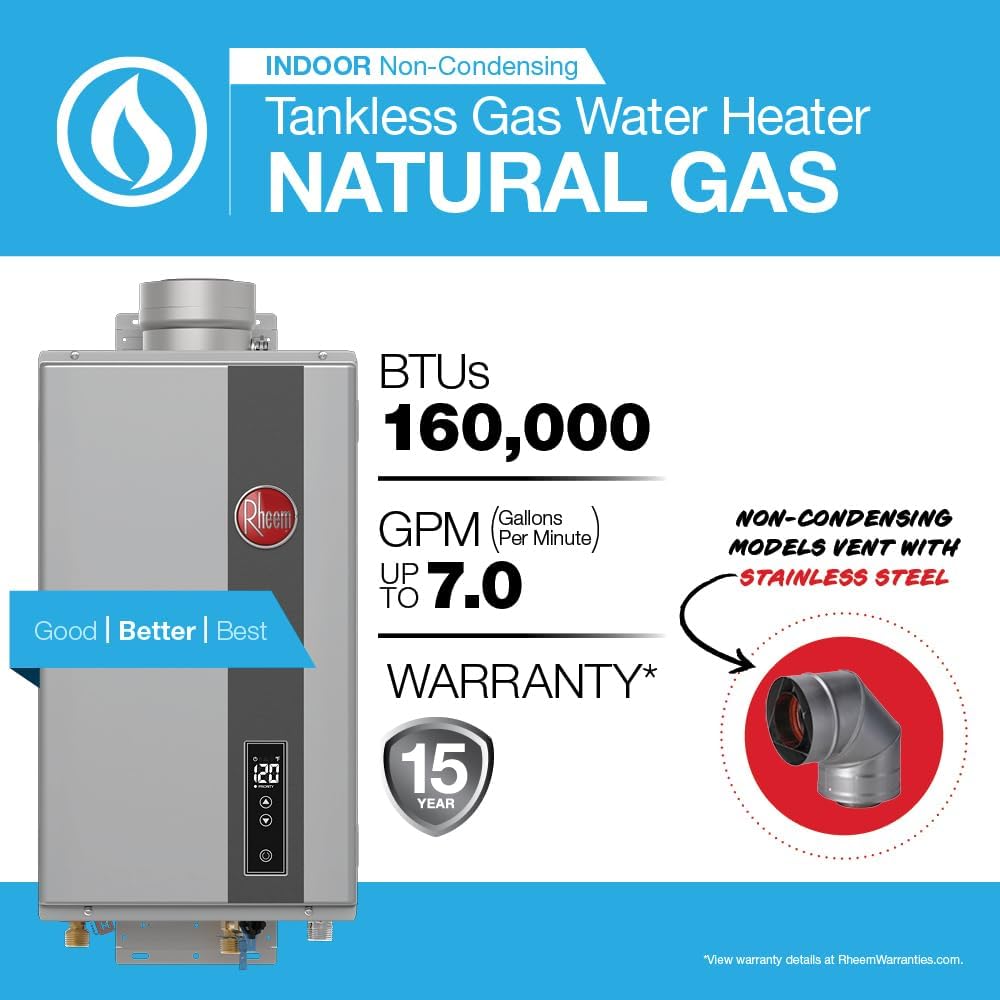
If you’ve ever replaced a big storage tank water heater — the barrel-shaped unit that sits in your utility room and keeps 40 or 50 gallons of water hot around the clock whether you need it or not — and wondered whether you could just heat water on demand instead, that’s exactly what a tankless water heater does. It fires a gas burner only when a faucet opens, heats water as it flows through, and shuts off when you’re done. No standby heat loss, no waiting for a tank to recover. The Rheem RTG line is one of the most widely specified non-condensing tankless families in North America. “Non-condensing” means the unit doesn’t extract latent heat from exhaust gases the way a higher-efficiency condensing unit does, which simplifies venting but affects efficiency ratings. If you have a project under contract or a quote on your desk and you’re sorting out which RTG variant actually fits the application, this article maps every option and names the tradeoffs plainly.
| EDITOR'S PICK[Rheem IKONIC RECTGH-SR84iN Prof…](https://www.amazon.com/dp/B0C825Y8MN?tag=greenflower20-20) | Mid-tier[Rheem RTG-70DVLP-3 High Efficie…](https://www.amazon.com/dp/B0C82611LN?tag=greenflower20-20) | Budget pick[Rheem RTG-70XLN-3 High Efficien…](https://www.amazon.com/dp/B0C827FQPG?tag=greenflower20-20) | |
|---|---|---|---|
| Type | Condensing | Non-Condensing | Non-Condensing |
| Location | — | Indoor | Outdoor |
| Flow Rate | 8.4 GPM | 7.0 GPM | 7.0 GPM |
| Fuel | Natural Gas | Liquid Propane | Natural Gas |
| Recirculation | ✓ | ✗ | ✗ |
| WiFi | — | ✗ | ✗ |
| Price | $1,538.14 | $804.00 | $785.99 |
| See on Amazon → | See on Amazon → | See on Amazon → |
What “Non-Condensing” Actually Costs You (and What It Saves)
Let’s anchor the efficiency conversation before diving into variants. A condensing tankless unit pulls Uniform Energy Factor (UEF) ratings in the 0.95–0.97 range by extracting additional heat from exhaust gases that would otherwise leave through the flue. That secondary heat exchange produces acidic condensate — liquid water — that has to be drained, and it demands PVC or CPVC vent pipe because exhaust temperatures drop low enough that stainless-steel flue pipe becomes unnecessary.
Non-condensing units like the Rheem RTG series run UEF ratings typically in the 0.82–0.84 range. According to the U.S. Department of Energy’s Energy Saver resource on tankless or demand-type water heaters, that is still meaningfully better than a standard storage tank (typically 0.60–0.67 UEF), but you are leaving roughly 10–14 efficiency percentage points on the table compared to a top-tier condensing unit. The tradeoff: exhaust exits hot (often 300–400°F), which means you vent with Category III stainless-steel pipe — the same type used for furnace flues — and there is no condensate to drain. On a retrofit where a stainless flue is already in place, or an outdoor installation where venting is a non-issue, that “efficiency penalty” becomes a genuine cost and complexity advantage.
The payback math is worth running explicitly. In most residential retrofits, a condensing unit carries a $300–$600 installed cost premium. The annual gas savings from the efficiency gap run roughly $60–$100 for an average household at typical natural gas rates, stretching the payback window to four to eight years. If existing flue infrastructure is stainless-steel compatible and the project timeline is tight, the RTG’s lower upfront friction is a legitimate engineering choice, not a compromise.
The Three Main Decision Axes: Location, Fuel, and BTU Tier
The RTG product matrix is organized along three variables: whether the unit mounts indoors or outdoors, whether it runs on natural gas or propane, and which BTU tier you need. Getting any one of these wrong means the unit ships back or the install fails inspection. The subsections below walk each axis.
H3: Indoor Units (RTG-Ci / DVN/DVP Series) — The Vented Option
Indoor RTG units require two-pipe direct venting: one pipe pulls combustion air in from outside (so the unit doesn’t deplete indoor oxygen or create backdraft conditions), and one exhausts combustion gases out. This sealed-combustion configuration is standard for any modern indoor gas appliance in a reasonably tight building envelope.
Vent runs use Category III stainless steel, typically 4-inch or 5-inch diameter depending on BTU rating and run length. The International Fuel Gas Code (IFGC) 2021, Chapter 6 — Specific Appliance Requirements governs maximum allowable vent lengths, and Rheem’s RTG Series installation documentation (2024–2025 edition) specifies equivalent vent lengths as hard limits, not guidelines. ACHR News, in its 2023 field reporting on non-condensing tankless venting considerations, identified undersized or over-length flue runs as the single most common cause of nuisance lockouts and error codes on this class of unit. That finding is worth bookmarking before you finalize any vent routing plan.
The indoor unit is the right call for a mechanical room, basement, or utility closet with exterior wall access within a manageable run — typically under 50 equivalent feet for a standard installation. If your utility room is interior with no practical path for a vent run, the indoor RTG cannot solve that; you are looking at a condensing unit with PVC run through a different wall, or a rethink of unit location entirely.

Rheem
$785.99
In stock on Amazon
Check price on AmazonH3: Outdoor Units (RTG-Co / PVN/PVP Series) — No Venting Required
The outdoor RTG chassis is weather-rated and freeze-protected. Per Rheem Manufacturing’s RTG Series Product Specification Sheets (2024–2025 edition), the outdoor models carry a freeze-protection rating down to -22°F via a built-in electric heating element on the heat exchanger. The unit requires no venting infrastructure at all — combustion air intake and exhaust both happen at the unit face, open to the outdoors. For new construction, additions, accessory dwelling units, or any situation where interior venting is expensive or code-complicated, the outdoor unit eliminates an entire category of labor cost and compliance work.
The install sequence is straightforward: gas connection, water connections, electrical (typically 120V for controls), done. The tradeoff is environmental exposure and the parasitic electrical draw of the freeze-protection element in sustained cold. Incoming groundwater temperature also matters significantly in cold climates — Rheem’s published flow rate data is based on a 77°F temperature rise. If your inlet water in January is 40°F and you need 110°F output, you are working with a 70°F rise that reduces effective flow rate at every BTU rating in the lineup.
The outdoor unit wins in nearly every retrofit where exterior wall placement is feasible. The indoor unit wins when aesthetics, HOA rules, or building configuration make exterior mounting impractical.
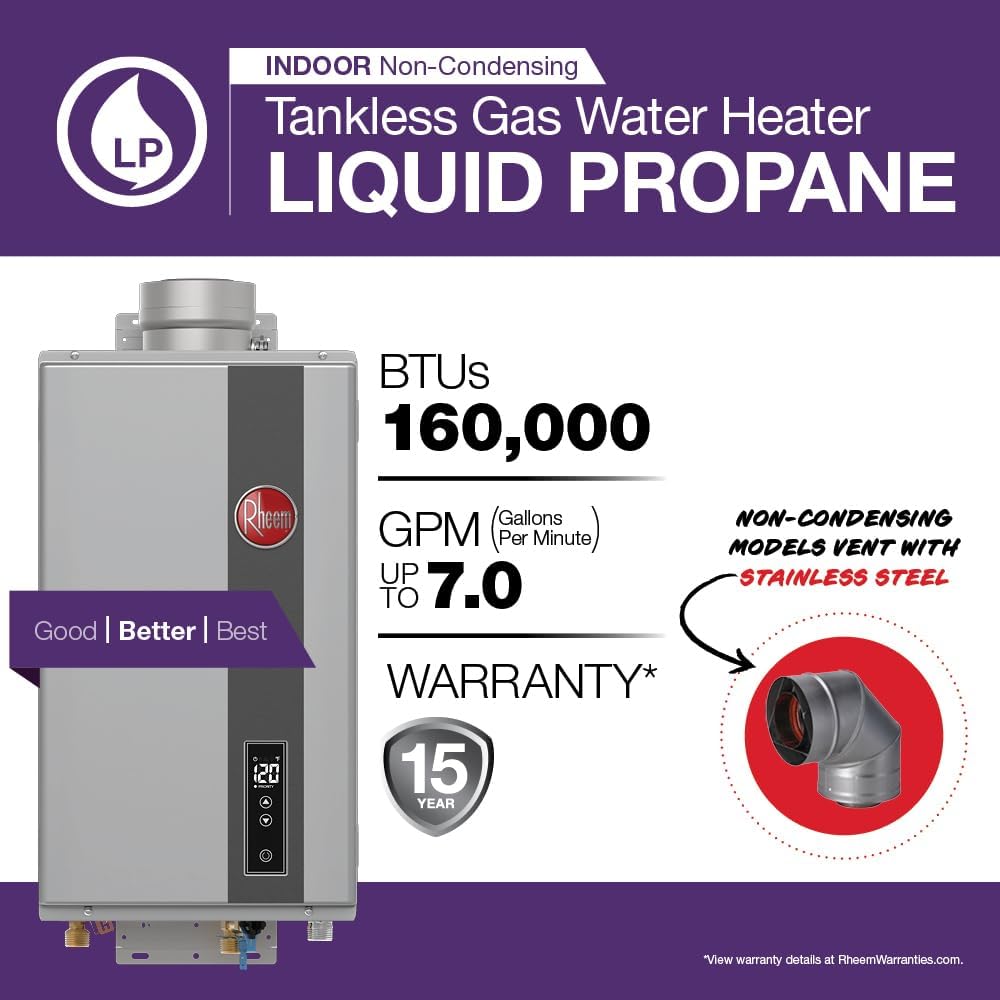
Rheem
$804.00
In stock on Amazon
Check price on AmazonH3: Natural Gas vs. Propane — Specify at Purchase, Not in the Field
Both indoor and outdoor RTG models are available in natural gas (NG) and liquid propane (LP) configurations. Per Rheem Manufacturing’s RTG Series Product Specification Sheets (2024–2025 edition), propane conversion requires orifice replacement and gas valve adjustment; done incorrectly, that process creates carbon monoxide risk and voids the warranty. The right approach is to specify the correct fuel type at the point of purchase.
Beyond orifice size, the fuel difference drives entirely separate sizing calculations. Propane delivers approximately 2,500 BTU per cubic foot versus natural gas at roughly 1,020 BTU per cubic foot — nearly 2.5 times the energy density. A propane unit runs at significantly lower gas volume flow rates to achieve the same BTU output, which means regulator sizing, supply line sizing, and tank capacity calculations are completely different exercises than they are for natural gas.
This Old House’s Tankless Water Heater Buying Guide flags one propane-specific detail that is frequently overlooked in cold-climate installations: propane tank regulators must be rated for low-temperature performance. A standard two-stage regulator can freeze up in sustained sub-zero weather, starving the unit of fuel at exactly the wrong moment. If you are specifying an RTG for a propane-supplied rural property, verify tank delivery capacity against peak demand (BTU per hour at max firing rate) and confirm regulator cold-weather ratings before finalizing the quote.
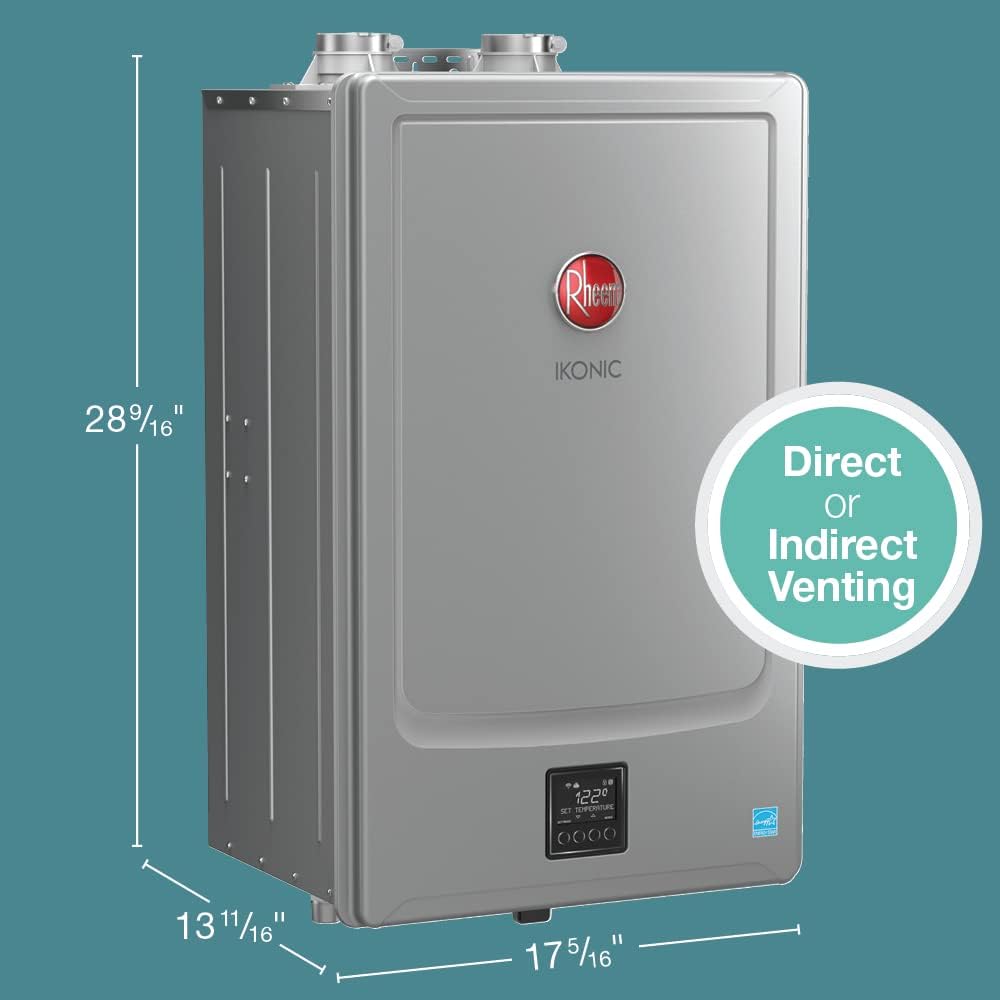
Rheem
$1,538.14
In stock on Amazon
Check price on AmazonThe Full RTG Variant Map
Here is how the product matrix shakes out as of Rheem’s 2024–2025 specification sheet publications. Flow rates are stated at a 77°F temperature rise; real-world effective flow drops as inlet water temperature falls.
| Model Series | Max BTU/hr | ~GPM (77°F rise) | Location | Fuel | Tier |
|---|---|---|---|---|---|
| RTG-74DVN | ~150,000 | ~7.4 | Indoor | Natural Gas | Entry |
| RTG-74DVP | ~150,000 | ~7.4 | Indoor | Propane | Entry |
| RTG-74PVN | ~150,000 | ~7.4 | Outdoor | Natural Gas | Entry |
Rheem
$785.99
In stock on Amazon
Check price on AmazonRheem
$804.00
In stock on Amazon
Check price on AmazonRheem
$1,538.14
In stock on Amazon
Check price on AmazonThe 95-series sits at the top of what a residential gas line can typically feed without significant upsizing. At 199,000 BTU/hr, verified gas supply capacity is not optional — it is the first thing to check before finalizing the specification. Undersized gas lines are a root cause of the RTG’s most commonly reported field complaint: modulation hunting and inconsistent outlet temperatures under simultaneous fixture demand. The IFGC 2021 and applicable local amendments govern minimum pipe sizing; do not assume an existing ¾-inch gas line is adequate without a pressure-drop calculation performed at max firing rate. ACHR News’s 2023 field reporting on non-condensing tankless installations specifically called out undersized gas supply — alongside over-length vent runs — as the two leading root causes of post-install callbacks on units in this BTU class.
If X, Then Y: The Decision Rules
You have absorbed the tradeoffs. Here is the clean decision frame for the most common project types.
If the install site has exterior wall access and lowest installed cost is the priority: Specify the outdoor RTG (RTG-xxPVN or RTG-xxPVP). Eliminating venting labor is the single largest cost lever available in this product category on a retrofit. No vent pipe, no penetration detailing, no equivalent-length calculations.
If the unit must go indoors and an existing stainless-steel flue is available: The indoor RTG is a natural fit. Verify equivalent vent length against Rheem’s published tables (RTG Series Product Specification Sheets, 2024–2025 edition) before finalizing the run. Per ACHR News’s 2023 field reporting on non-condensing tankless venting, vent length violations are the leading source of post-install callbacks — catching this at the design stage costs nothing; catching it after drywall is closed costs considerably more.
If you are comparing the RTG to a condensing unit on a new installation with no existing flue: Run the payback math explicitly. The U.S. Department of Energy’s Energy Saver resource on demand-type water heaters provides a methodology for estimating annual energy cost by fuel type and usage pattern. If the project’s energy use justifies a five-plus year horizon and local gas rates support it, the condensing unit’s higher UEF pays back meaningfully. If the timeline is shorter or retrofit friction is high, the RTG wins on total installed cost.
If the fuel source is propane: Specify LP at the factory. Verify tank capacity, regulator cold-weather ratings, and supply line sizing against peak BTU demand before quoting the job. This Old House’s Tankless Water Heater Buying Guide is a useful reference for communicating the regulator cold-weather issue to clients who are unfamiliar with propane system sizing.
If simultaneous fixture demand is a real concern — three or more bathrooms, or a recirculation loop planned: Size to the 95-series and get a gas supply capacity check done before finalizing the quote. A unit that cannot be fed adequately at full fire will generate callbacks regardless of how well every other aspect of the installation is executed. The IFGC 2021, Chapter 6 requirements on appliance-specific gas supply sizing are the applicable code floor; local amendments may be more restrictive.
The RTG line is not the highest-efficiency option Rheem offers, and it is not designed to be. What it is: a proven, widely-installed, contractor-familiar platform with strong parts availability, a straightforward venting story on retrofits where stainless infrastructure already exists, and a price point that makes sense when the project does not reward the added complexity of condensing technology. Know your site conditions, match the variant to the fuel and location constraints, run the gas supply calculation, and the RTG earns its specification.