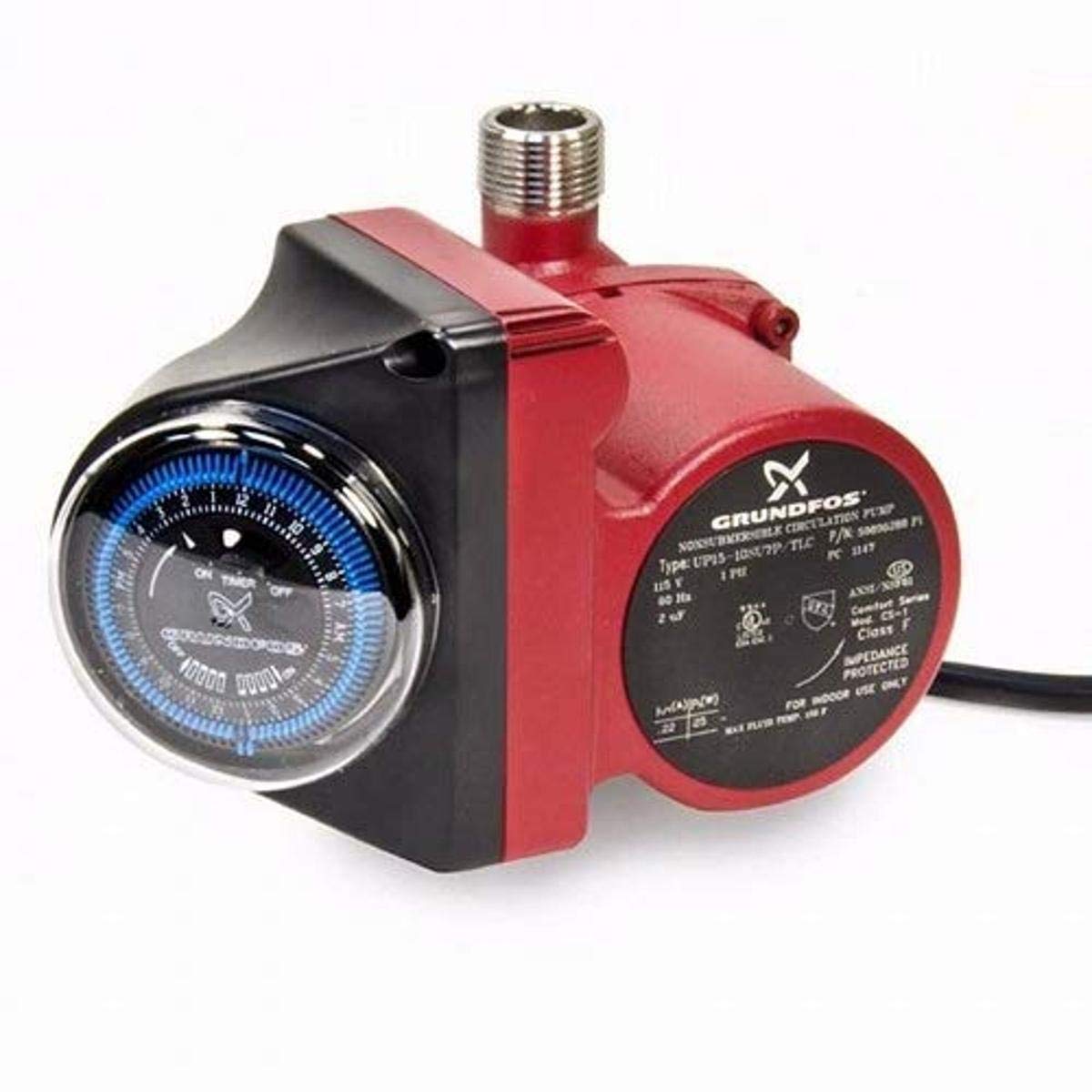
You’ve been there: you turn on the shower, step back to avoid the cold blast, and wait. And wait. Depending on how far your bathroom is from your water heater, that wait can stretch to a full minute or two — and every second of it, clean drinkable water is swirling straight down the drain. A hot water recirculation pump (sometimes called a “recirc pump”) solves this by keeping a small loop of hot water continuously — or strategically — moving through your pipes so it arrives almost instantly when you open a faucet. The concept is simple: instead of letting the water in your supply lines go cold between uses, the pump pushes a trickle of hot water back toward the heater and keeps it ready. This guide will help you understand how these systems work, which type fits your situation, what the real tradeoffs are on energy and water savings, and how to make a confident decision whether you’re upgrading a single-family home or spec-ing a multi-bath property.
| EDITOR'S PICK[Grundfos GRU-595916 Recirculati…](https://www.amazon.com/dp/B000JG81AQ?tag=greenflower20-20) | Mid-tier[Watts Heat H2O Hot Water Recirc…](https://www.amazon.com/dp/B0D4NTC59R?tag=greenflower20-20) | Budget pick[CrestWave Hot Water Recirculati…](https://www.amazon.com/dp/B0D6FT9ZD5?tag=greenflower20-20) | |
|---|---|---|---|
| Wattage | 25W | — | 125W |
| Timer | — | ✓ | — |
| Easy Install | ✓ | ✓ | — |
| Warranty | — | 3 Year | — |
| Kit Complete | ✓ | — | — |
| Price | $323.00 | $268.84 | $59.99 |
| See on Amazon → | See on Amazon → | See on Amazon → |
Why Recirculation Pumps Actually Matter (the Math Doesn’t Lie)
Before getting into hardware, it’s worth grounding the decision in numbers — because the case for a recirc pump isn’t just about convenience. It’s a legitimate water and energy story.
By the numbers:
- The EPA WaterSense program estimates the average U.S. household wastes 20–30 gallons per day waiting for hot water to arrive — roughly 9,000 gallons per year.
- At current (2026) average U.S. water/sewer rates of about $0.015–$0.020 per gallon combined, that’s $135–$180 in wasted water annually for a typical home.
- A properly configured demand-type recirc pump draws roughly 25–85 watts and adds an estimated $15–$40/year in electricity cost at national average rates.
That math favors installation in most climates — especially in drought-sensitive states like California, Arizona, and Colorado where tiered water pricing can make wasted gallons significantly more expensive. Per the U.S. Department of Energy’s Energy Saver guidance, pairing a recirculation pump with an already-efficient water heater (especially a heat pump water heater or condensing tankless) amplifies the whole-system savings story rather than working against it.
The tradeoff that practitioners often underweight: a full-loop system runs your supply lines warmer continuously, which slightly increases standby heat loss from those pipes. That cost is real, and it matters more in uninsulated crawl spaces than in conditioned spaces. We’ll come back to that when we get to system selection.
The Three System Types — and When Each One Wins
There is no single “best” recirc pump. The right answer depends on your plumbing layout, how often the fixture is used, who’s paying the utility bill, and whether you have a dedicated return line already in the wall.
Type 1: Full Dedicated-Loop System
This is the setup you’ll find in homes that were plumbing-forward from day one — a separate return line runs from the farthest fixture back to the water heater inlet, and a pump (typically a small circulator in the 1/25 to 1/40 horsepower range) sits either at the heater or somewhere along the return. The Grundfos UP15-18B7/TLC and the Watts Premier series are frequently specified here.
The upside: hot water is genuinely immediate across the whole loop, and the pump can be timer-controlled or aquastat-controlled (meaning it runs only when the water in the line drops below a set temperature) so you’re not burning electricity around the clock.
The downside: if your home wasn’t built with a dedicated return line, retrofitting one requires opening walls. In a full renovation, that cost may be absorbed. On a finished property, it’s often a deal-breaker.
Best fit: new construction, whole-home gut renovations, or properties already wired for a loop (common in homes built after ~2000 in water-conscious markets).
Type 2: Comfort Valve / No-Return-Line System
This is where the market has exploded in the past decade. A valve installed at the farthest fixture connects your hot supply line to your cold supply line and acts as a bypass — when the pump runs, it pushes warm water from the hot line through the cold line and back to the heater. No new pipes required.
The Watts 500800 and the Grundfos Comfort series dominate owner reviews in this category. Per Popular Mechanics’ comparative overview of recirc pumps, the Grundfos Comfort UP15-14B7/TLC is consistently flagged as a reliable performer in retrofit scenarios.
The honest tradeoff: this system slightly warms your cold water line. For most homeowners, that’s unnoticeable. In hot climates or in situations where someone is drawing a cold glass of water immediately after the pump cycles, the lukewarm sensation is a minor annoyance. More importantly, some plumbing codes (check your local authority having jurisdiction) have language about cross-connection valves that installers need to verify. This Old House’s installation guide covers the comfort valve setup clearly and is worth reviewing before your plumber scopes the job.
Best fit: retrofit applications on finished properties, landlords adding the amenity without major construction, and point-of-use applications for a single remote bathroom.
Type 3: On-Demand / Smart Pump Systems
These are essentially comfort-valve or dedicated-loop pumps paired with demand controls — a push-button, motion sensor, or smart-home integration (Z-Wave, Zigbee, or Wi-Fi) that triggers the pump only when someone is about to use hot water. The Metlund D’mand system and the Chilipepper CP6000 are the canonical examples here; Rheem’s smart recirculation option built into the ProTerra and Prestige Hybrid Heat Pump lines is increasingly where buyers in the premium segment are landing.
Why this matters for energy math: a comfort-valve system running on a 24/7 timer adds measurable standby heat loss to your cold supply line. An on-demand system eliminates that entirely — the pump runs for 30–90 seconds when triggered, hot water arrives, pump shuts off. Owners across aggregated reviews consistently note that the demand approach eliminates the “lukewarm cold water” complaint too, since the cold line never stays warm.
The friction: someone has to push the button (or wave at the sensor). In households with a consistent routine, that’s trivial. In a rental or short-term stay property where guests don’t know the system, it can cause confusion. Some smart integrations (particularly in Rheem’s EcoNet ecosystem) handle this through learned scheduling, which closes the gap.
Best fit: energy-conscious homeowners, premium builds where smart-home integration is already in place, and situations where the cold-water temperature complaint is a known objection.
Sizing and Compatibility Factors That Practitioners Get Wrong
The pump selection itself is rarely the hard part. The harder decisions are around system compatibility, and this is where projects tend to stall.
Tankless water heaters and recirculation: this pairing requires attention. Most tankless units have a minimum flow rate (typically 0.5–0.75 GPM) required to fire the burner. Recirculation pumps typically move 0.5–1.0 GPM in a loop, which can keep the unit trying to light — or cycling on and off in a way that stresses the heat exchanger. Rinnai, Navien, and Noritz all publish dedicated recirculation guidance; Navien’s NPE-A2 series and Rinnai’s RUR (Sensei) line have built-in recirculation ports and pump-ready designs specifically to address this. If you’re spec-ing a tankless unit and a recirc system, matching them from the same manufacturer’s recirc-ready lineup eliminates most of the compatibility friction. The U.S. Department of Energy’s Energy Saver section on tankless heaters flags this as a key installation consideration.
Pipe material: brass-bodied pumps are compatible with copper and CPVC. Some older galvanized systems can cause pump wear faster than rated. PEX compatibility depends on the specific pump head and fitting — verify with the manufacturer spec sheet before committing.
Pump sizing (head pressure): most residential applications fall well within the range of a 1/25 HP circulator pump (roughly 6–10 feet of head). Properties with very long loop runs (over 200 feet of pipe) or multiple stories may need a modest step up. Your plumber should do a quick head loss calculation; the pump manufacturers publish selection charts that make this straightforward.
The Decision Frame: If X, Then Y
Here’s how to translate all of the above into a clear path forward:
If you’re on a finished, single-family property and don’t want to open walls: Specify a comfort-valve retrofit system (Grundfos Comfort or Watts 500800 series) with a timer or aquastat control. Budget $200–$450 for hardware plus 2–4 hours of plumber time. This is the fastest ROI path on water savings.
If energy efficiency is the primary driver and you can tolerate a button or sensor: Go on-demand (Metlund D’mand or Chilipepper CP6000, or Rheem’s EcoNet-integrated option if you’re already on a Rheem heater). You’ll eliminate standby heat loss and the cold-water-line warming complaint simultaneously.
If you’re spec-ing new construction or a full renovation: Install a dedicated return line and a timer/aquastat-controlled loop pump. It costs more upfront (return line rough-in adds $300–$800 depending on layout), but it’s the cleanest long-term solution with no cold-water crossover and no push-button friction.
If you’re pairing with a tankless heater: Verify the unit has a built-in recirculation port (Rinnai RUR, Navien NPE-A2, Noritz NRCP series). Do not assume a standard recirc pump will play nicely with a standard tankless unit without confirming minimum flow compatibility — the failure mode isn’t dramatic, but repeated short-cycling shortens heat exchanger life.
If you’re managing a multi-unit or light-commercial property: Dedicated loop with a commercial-grade circulator (Taco, Bell & Gossett, or Grundfos commercial line) and BACnet-compatible controls if your building management system supports it. The water savings across 8–20 units adds up to a meaningful operating cost reduction, and the guest/tenant experience argument is easy to make to ownership.
The Bottom Line
A recirculation pump is one of the few home plumbing upgrades where the convenience payoff is immediate and the water savings math closes quickly enough to justify the spend on pure economics — especially in markets with tiered water rates. The hardware decision is secondary to the system architecture decision: dedicated loop vs. comfort valve vs. on-demand. Get the architecture right for your property type and plumbing layout, verify compatibility with your water heater (especially if you’re on tankless), and the pump selection itself becomes almost routine.
The one thing worth repeating: don’t over-engineer the pump while under-engineering the controls. A $180 circulator running 24/7 on a comfort-valve system can eat back half your water savings in standby heat loss. A timer, aquastat, or demand controller typically adds $30–$80 to the project cost and can pay for itself in the first season. Owners who’ve dialed in the controls consistently report that the system becomes invisible in the best possible way — hot water just shows up, and nobody thinks about it again.