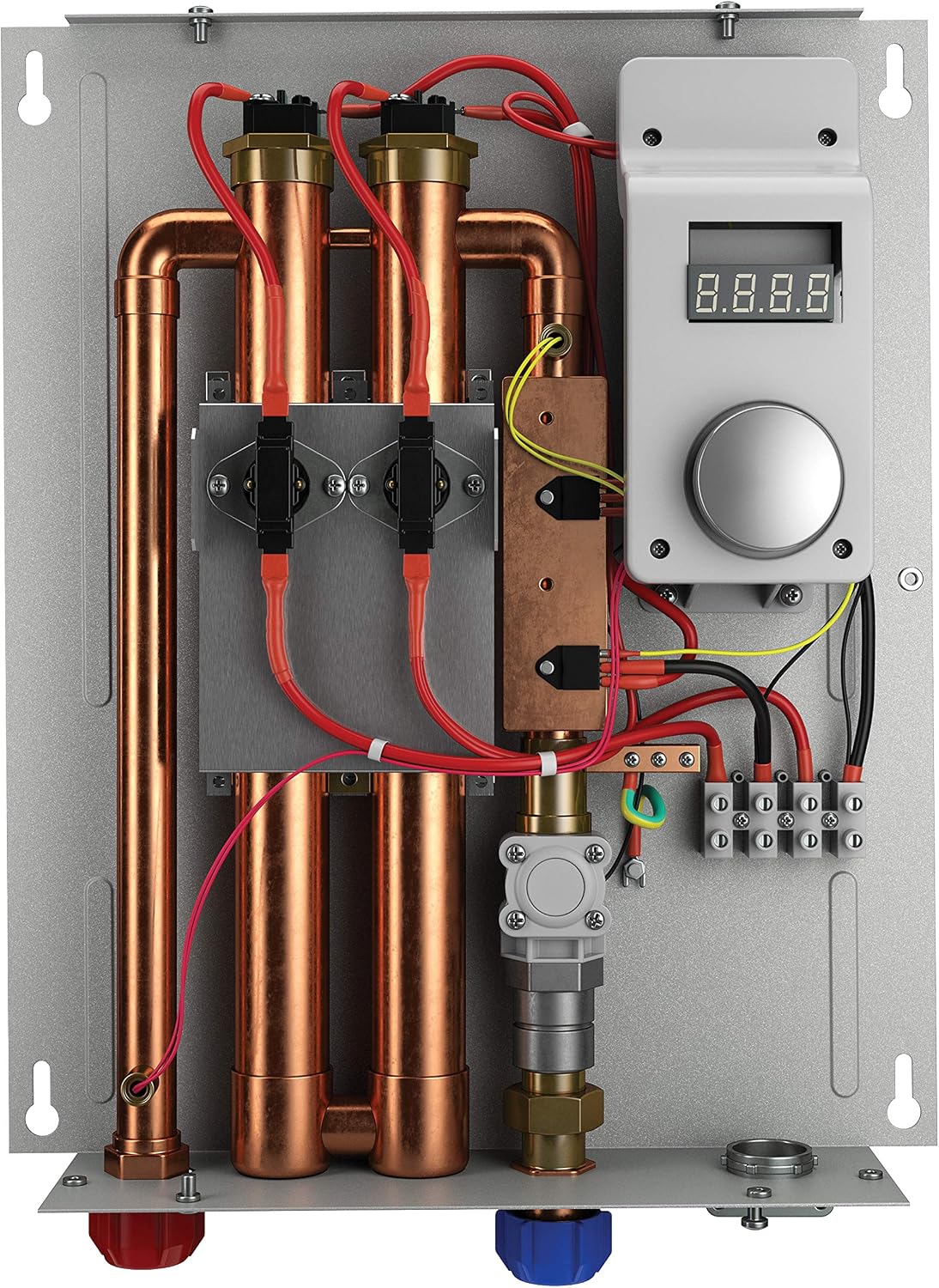
An electric tankless water heater heats water on demand — no storage tank, no standby heat loss, just cold water in and hot water out whenever you open a tap. That sounds simple, but the “on demand” part has a catch: the heater has to produce all of that heat instantly, which takes a tremendous surge of electricity. The limiting factor almost always turns out to be your electrical panel — the gray metal box in your utility room that distributes power throughout your home — specifically how many amps (a measure of electrical current) it can spare for the water heater. Gallons per minute (GPM), the flow-rate spec manufacturers put on the box, matters too, but if your panel can’t supply the amperage the heater needs, the GPM rating is irrelevant. This article walks through the math, explains where buyers get tripped up, and ends with a clear decision framework so you can walk into a contractor conversation — or a purchasing decision — knowing exactly what you need.
| EDITOR'S PICK[Stiebel Eltron Tankless Water H…](https://www.amazon.com/dp/B07GYQHWYJ?tag=greenflower20-20) | Mid-tier[EcoSmart ECO 18 Electric Tankle…](https://www.amazon.com/dp/B0047V0KSU?tag=greenflower20-20) | Budget pick[EcoSmart ECO 11 Electric Tankle…](https://www.amazon.com/dp/B001LZRF9M?tag=greenflower20-20) | |
|---|---|---|---|
| Power (kW) | 28.8 | 18 | 13 |
| Voltage | — | 240V | 240V |
| Dimensions | — | 17 x 14 x 3.5 | 12 x 8 x 4 |
| Self-Modulating | — | ✓ | ✓ |
| Price | $694.87 | $368.00 | $206.76 |
| See on Amazon → | See on Amazon → | See on Amazon → |
Why Amperage Beats GPM in the Sizing Conversation
Most buyers approach electric tankless sizing the wrong way. They start with GPM (“I need 3.5 GPM to run a shower and a kitchen faucet simultaneously”) and then find a heater rated for that flow. The problem: GPM ratings on electric tankless units are calculated at a specific temperature rise — typically 35°F or 45°F — and at a specific input wattage that requires a specific amperage. Change the incoming water temperature or the available amperage, and the effective GPM drops immediately.
The U.S. Department of Energy’s guidance on tankless water heaters (Energy.gov, “Tankless or Demand-Type Water Heaters”) is explicit: “the flow rate determines how much hot water the unit can provide per minute,” but it also notes that incoming water temperature is a critical co-variable. In colder climates — the northern U.S., Canada, high-altitude installations — groundwater can arrive at 40°F to 50°F, meaning the heater has to raise water temperature by 70°F to 80°F to reach a usable 120°F. That takes significantly more power than the 35°F rise used in manufacturer marketing claims.
Here’s the core relationship:
Power (watts) = Flow Rate (GPM) × Temperature Rise (°F) × 500
That 500 is a simplified engineering constant (actually closer to 499.8 when you account for water’s specific heat and unit conversions). Run the math on a real scenario:
By the numbers — sizing a whole-house unit in a cold climate:
- Target flow: 2.5 GPM (one shower + one lavatory)
- Incoming water temp: 45°F; target delivery: 120°F → temperature rise: 75°F
- Required wattage: 2.5 × 75 × 500 = 93,750 watts ≈ 94 kW
- At 240V: 94,000 ÷ 240 = ~392 amps — far beyond any residential panel
That result is not a typo. It’s why true whole-house electric tankless heating in a cold-climate scenario is genuinely difficult, and why most residential panels (100A to 200A service) constrain your options before GPM enters the conversation.
What Your Panel Actually Gives You to Work With
Residential electrical service in the U.S. runs at 240 volts and comes in standard sizes: 100-amp, 150-amp, 200-amp, and (in newer construction or upgraded homes) 400-amp service. The panel ampacity — the total current the panel is rated to handle — is not entirely available to a new water heater. You have to account for everything else already on the panel: HVAC, electric range, dryer, EV charger, and the baseline load of lighting and outlets.
The National Electrical Code (NEC) Article 422 adds another layer: continuous loads — devices that run for three hours or more — must be sized at 125% of their rated amperage on the circuit breaker. An electric tankless water heater qualifies. So a heater drawing 150 amps requires a 187.5-amp breaker, rounded up to 200A — which is the entire capacity of a standard 200A panel before a single other circuit is considered.
A practical headroom table:
| Panel Size | Realistic Available for Water Heater | Max Heater Draw (NEC 125% rule) | Approximate Max kW |
|---|---|---|---|
| 100A service | ~40–50A spare | 32–40A continuous | ~7.7–9.6 kW |
| 150A service | ~60–80A spare | 48–64A continuous | ~11.5–15.4 kW |
| 200A service | ~80–100A spare | 64–80A continuous | ~15.4–19.2 kW |
| 400A service | ~150–200A spare | 120–160A continuous | ~28.8–38.4 kW |
This table uses conservative assumptions; actual available amperage depends on your specific load calculation. Have a licensed electrician perform a load calculation before finalizing any unit selection.
The practical takeaway: on a standard 200A panel with typical household loads, you’re realistically looking at 18 kW to 24 kW of usable electric tankless capacity. That supports 1.5 to 2.5 GPM of temperature rise depending on your climate — enough for point-of-use applications or mild-climate whole-house use, but not enough for a cold-climate three-bath home without panel upgrades.
How the Leading Units Map to These Constraints
Stiebel Eltron Tempra Plus Series
The Tempra Plus lineup (Tempra 24 Plus, 29 Plus, 36 Plus) is the most frequently cited residential whole-house electric tankless line in aggregated installer reviews, and it earns that position largely because of its Advanced Flow Control feature. Per Stiebel Eltron’s published specification sheets, Advanced Flow Control automatically reduces flow rate to maintain target output temperature when incoming demand exceeds the unit’s capacity — instead of delivering lukewarm water at full flow, it delivers hot water at reduced flow. That’s a meaningful real-world tradeoff that owners consistently report appreciating over units that simply can’t keep up.
The Tempra 36 Plus is rated at 36 kW and draws 150 amps at 240V, requiring a 200A dedicated circuit (per NEC 125% rule). On a 200A panel with average household loads, this is at or beyond the limit. On a 400A panel or with a panel upgrade, it’s the strongest residential whole-house electric option in this class. Popular Mechanics’ overview of tankless water heaters notes the Stiebel Eltron line as a benchmark for electric whole-house performance.
The Tempra 29 Plus at 29 kW (120.8A draw, ~151A breaker requirement) is more realistic on a 200A panel with modest existing loads. In mild-climate markets — the Southeast, Southwest, Pacific Coast — where incoming water temperatures run 60°F to 70°F, it delivers genuine whole-house capability.
Eemax Commercial Electric Series
For light-commercial applications — boutique hotel guest rooms, catering prep sinks, small food-service hand-wash stations — the Eemax commercial electric lineup offers NSF-compliant units with field-selectable wattage settings. Eemax’s published documentation shows models ranging from 18 kW to 54 kW with modular configurations. The wattage-selectable design lets an installer dial back power draw to match available panel capacity, which operators in long-run reviews note as a genuine advantage during phased electrical upgrades. At the 27 kW to 36 kW range, Eemax commercial units require the same 200A+ dedicated service as the Stiebel Eltron whole-house units, but with the added compliance of NSF certification for food-service adjacency.
Bosch Tronic 3000 Series (Point-of-Use)
The Bosch Tronic 3000 line occupies a different position: these are point-of-use units (typically 3.5 kW to 18 kW) designed for a single fixture or zone, not whole-house service. At the low end, they run on a standard 30A to 60A circuit, making them the right answer when panel capacity is the hard constraint. This Old House’s installation guidance consistently frames point-of-use electric tankless as the pragmatic solution for kitchens, master baths, or additions where running a whole-house unit isn’t feasible. If your panel assessment comes back with limited headroom, a point-of-use unit at the fixture — combined with your existing tank heater for the rest of the home — is frequently the most cost-effective path.
The Panel Upgrade Math: When It Pencils and When It Doesn’t
A panel upgrade from 200A to 400A service runs $2,500 to $5,000 in most U.S. markets as of mid-2026, including utility coordination and permit fees. That cost is real and has to be weighed against what you’re buying.
If you’re in a mild-to-moderate climate (incoming water temp above 60°F) and already have a 200A panel with reasonable headroom, a Tempra 29 Plus or comparable 24–30 kW unit often installs without a panel upgrade, making the economics straightforward.
If you’re in a cold climate (incoming water below 55°F) and want true whole-house coverage, you’re either looking at a panel upgrade to 400A service, a hybrid approach (gas tankless or heat-pump water heater for base load + electric point-of-use for remote fixtures), or accepting that electric tankless at whole-house scale requires serious infrastructure investment.
The Department of Energy’s guidance on this topic is measured: for cold climates, gas tankless or heat-pump water heaters (where the gas line or space permits) often deliver better whole-house efficiency economics than pushing large-draw electric tankless units. The UEF (Uniform Energy Factor — the standardized efficiency rating for water heaters) on a Rheem Prestige Hybrid Heat Pump or similar heat-pump water heater runs 3.5 to 4.0+ UEF, compared to 0.96–0.99 UEF for electric resistance tankless. In markets with high electricity rates, that gap compounds quickly.
Decision Framework: If X, Then Y
Use this to finalize your approach before the next contractor conversation:
If your panel is 200A with moderate existing loads and you’re in a mild climate (incoming water >60°F): → A 24–29 kW electric tankless (Tempra 24 Plus, Tempra 29 Plus range) is likely feasible without a panel upgrade. Get a load calculation to confirm headroom, then size by actual GPM demand with your local groundwater temperature plugged in.
If your panel is 200A but heavily loaded (EV charger, electric HVAC, electric range): → Point-of-use electric tankless at the highest-demand fixture (Bosch Tronic 3000 or comparable) combined with your existing tank heater is the practical path. Or budget for a panel upgrade.
If your panel is 100A or 150A: → Whole-house electric tankless is not the right tool. Point-of-use units for specific fixtures, or a full panel upgrade as part of a broader home electrical modernization, are the correct frames.
If you’re in a cold climate (incoming water <55°F) and want whole-house coverage: → Reconsider the technology. A heat-pump water heater with a recirculation loop or a high-efficiency gas tankless unit almost always delivers better economics. If electric is a hard requirement (all-electric home, no gas line), budget for 400A service and a 36 kW+ unit, and have the numbers reviewed by both an electrician and a plumber who can confirm flow rates at your fixtures.
If you’re a light-commercial operator needing NSF compliance and flexible wattage: → The Eemax commercial electric series is the spec to evaluate first. The field-selectable wattage is a real operational advantage when you’re managing phased infrastructure improvements.
The panel ampacity conversation is not a formality — it’s the decision. Get that number from a licensed electrician before you fall in love with a GPM rating on a box.